Paris Short-Term Rental Licensing 2026
TL;DR: In Paris, primary residences can be rented short-term for up to 90 nights per year with a registration number from the Mairie. Secondary residences require a changement d’usage authorization that Paris grants rarely due to strict compensation requirements. Loi Le Meur (November 2024) gives Paris the power to lower that cap below 120 days, and Paris has used that power to set the primary-residence cap at 90 nights. Get the registration number before your first night, regardless of which path applies to you.
Key facts (as of July 2026)
- Primary residence in Paris: rent as a furnished tourist rental up to 90 nights per calendar year (source: Ville de Paris).
- A registration number (numero de declaration) must appear on every listing before the first night.
- Secondary residence: no night cap, but requires a changement d’usage authorization with a compensation requirement Paris grants rarely.
- Failure to register: fine up to 5,000 EUR per listing.
- Operating a secondary residence without changement d’usage: civil penalties up to 100,000 EUR plus forced return to residential use.
- The 90-night cap counts confirmed check-in nights, aggregated across all platforms, resetting January 1.
Who this covers
This guide is for STR operators who own or manage properties in Paris: owners renting their primary Parisian residence part-time, operators with secondary residences in Paris, and portfolio managers considering Paris acquisitions. It does not cover hotels, serviced apartments operating under commercial tourism licenses, or furnished rentals beyond 90 days.
The framework below reflects Article L324-1-1 of the Code du tourisme as modified by loi ELAN (2018) and loi Le Meur (November 2024), plus Paris-specific municipal rules on changement d’usage. Sources are cited inline. Information current as of July 2026; verify all regulatory details before acting.
Prerequisites
Before reading the step-by-step sections, confirm which category your Paris property falls into.
Primary residence (résidence principale): Where you physically live for at least 8 months per year. The 8-month threshold is set by Article L324-1-1 of the Code du tourisme. A pied-à-terre you use on weekends does not qualify. A flat where you sleep most nights of the year, even if you travel frequently, typically qualifies.
Secondary residence (résidence secondaire): Any Paris property that is not your primary residence. This includes investment properties, inherited apartments, pied-à-terres, and any property where you spend fewer than 8 months per year.
The category determines everything: your licensing path, your night cap, and your fine exposure. Getting this wrong is the most expensive mistake Paris operators make.
| Primary residence | Secondary residence | |
|---|---|---|
| Trigger criterion | You live there 8+ months/year | You live there fewer than 8 months/year |
| Licensing step | Télédéclaration on teleservices.paris.fr | Changement d’usage authorization required |
| Outcome of step | Receive registration number | Authorization rarely granted by Mairie |
| Annual STR cap | 90 nights (Paris, loi Le Meur; national default 120) | No night cap, but compensation rule applies |
| Compensation requirement | None | Convert equivalent surface commercial space to residential, same arrondissement |
| Penalty exposure | Up to €5,000 per listing without registration number | Up to €100,000 (Article L651-2) + forced return to residential use |
Decision path: the single question that splits everything: do you live there 8+ months/year? (Article L324-1-1)
Yes, primary residence path:
- File the télédéclaration at
teleservices.paris.fr. - Receive your numéro de déclaration.
- Post that number on every OTA (Airbnb, Vrbo, Booking.com).
- Paris has set the primary-residence cap at 90 nights/year (national default is 120 for cities that have not lowered it). Verify the current figure with your Mairie.
No, secondary residence path:
- Pre-2015 changement d’usage authorization in hand: operate within the authorization’s scope.
- No prior authorization: you need capital to acquire compensation commercial space in the same arrondissement:
- Can acquire it: apply for changement d’usage + acquire the space. Rarely granted.
- Cannot: the market is effectively closed, up to €100,000 in fines plus forced return to residential use.
Primary residence: the 90-night path
This is the accessible path for most operators who own one Paris property.
Step 1: File your télédéclaration before the first night
No STR activity in Paris is legal before you have a registration number. The declaration is free and typically processes within a few days.
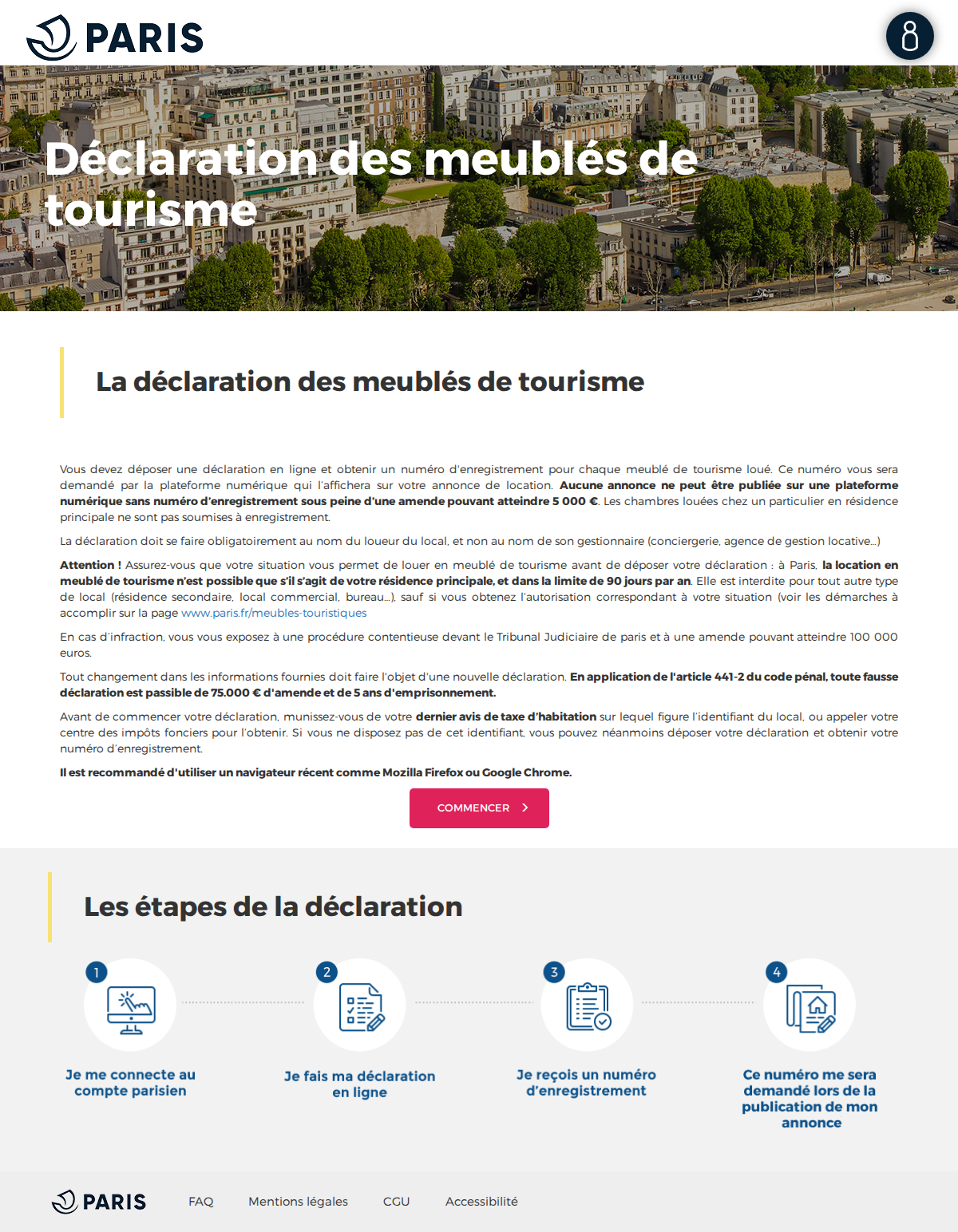
The process as documented by the Mairie de Paris:
- Access the official Paris teledeclaration portal, or via the service-public.gouv.fr guide on furnished tourist rentals
- Submit the property address and confirm it is your primary residence
- Receive your numéro de déclaration - a unique alphanumeric identifier
You do not need to submit tax documents or proof of ownership to get the number. You are making a sworn declaration. The Mairie de Paris has enforcement mechanisms to verify declared primary residences during compliance investigations. Declarations that are inconsistent with your fiscal domicile create legal exposure if investigated.
If the property is owned through an SCI (Société Civile Immobilière), the declaration process involves additional steps specific to corporate ownership. A notaire or property lawyer should handle that case.
Step 2: Post your registration number on every listing
This is non-negotiable and applies to every platform simultaneously. Airbnb, Vrbo, Booking.com, and any direct booking page must display the registration number. A single unlisted channel creates compliance exposure.
Platforms operating in France are required by law to verify that listings include valid registration numbers for municipalities that mandate them. Paris mandated registration since 2017. The fine for operating without a valid registration number is up to 5,000 EUR per listing per Article L324-1-1 of the Code du tourisme, as confirmed by service-public.gouv.fr. Platforms hosting non-registered listings face separate civil penalties under the Code du tourisme platform accountability provisions; consult the current consolidated text at legifrance.gouv.fr for applicable amounts.
Step 3: Track the 90-night counter
The counter resets on January 1. “Nights” means check-in nights confirmed, not reservation dates or booking dates. A booking made in December for a January stay counts against the new year’s quota.
The 90-night ceiling is absolute. Dynamic pricing affects revenue per night, not nights available - and the cap makes a nights-constrained property behave very differently from a secondary STR with no annual limit. Read when dynamic pricing hurts more than it helps before enabling any pricing algorithm on a capped property.
What Airbnb does automatically: Airbnb blocks additional bookings once a primary-residence Paris listing confirms 90 nights in a calendar year, but only for listings correctly configured as primary residences on Airbnb. Vrbo and Booking.com do not enforce this automatically. If you list across multiple OTAs, you must track total confirmed nights across all channels manually or via your PMS.
Operators commonly use channel managers to consolidate availability across OTAs for this purpose - both Hostaway and the alternatives covered in our Guesty alternatives piece offer calendar sync across major OTAs. The regulation requires that listings stop accepting new bookings once 90 confirmed nights are reached for the calendar year; the unified calendar is how most multi-OTA operators enforce this.
The loi Le Meur wrinkle on the 120-night cap
Law 2024-1039 (loi Le Meur, November 19, 2024) allows municipalities to lower the annual STR cap for primary residences below 120 days, to a statutory floor of 90 days.
As of July 2026, Paris has set the cap at 90 nights per year for primary residences (source: Ville de Paris). Operating at 120 nights when the Paris rule is now 90 is a violation, even with a valid registration number.
Secondary residence: the changement d’usage path
If the property is not your primary residence, the 90-night cap does not apply. Instead, you need a changement d’usage authorization - a formal municipal approval to use residential space for commercial short-term rental purposes.
What changement d’usage means in Paris
French housing law classifies residential property separately from tourist accommodation. Using a Paris secondary residence for short-term rental on a commercial basis constitutes a change of use from residential to commercial (more precisely, to “hébergement touristique”). Article L631-7 of the Code de la construction et de l’habitation requires municipal authorization for this change in cities with more than 200,000 inhabitants, including Paris.
For most French cities, the process is administrative. In Paris, it is materially harder due to a compensation rule that Paris applies more strictly than almost any other French municipality.
The compensation requirement
To obtain a changement d’usage authorization in Paris, the applicant must simultaneously convert an equivalent surface of commercial or office space to residential use in the same arrondissement (or within the same administrative sector for some cases). This is the “compensatoire” requirement.
The mechanics: you buy commercial space (or have rights to it), convert it to residential, and present that conversion as compensation for the residential space you are converting to STR use. Paris issues both approvals together.
Why this nearly closes the market to new entrants: the compensatoire requirement means every secondary STR authorization requires acquiring an equivalent area of commercial space first. For a 40m² apartment, the operator must source, acquire, and convert 40m² of commercial space in the same arrondissement. This is a significant capital commitment on top of the property itself, which explains why the authorization path is practical mainly for operators with existing commercial holdings or pre-2015 legacy authorizations obtained before Paris tightened enforcement.
Paris tightened enforcement of the compensation requirement significantly around 2015-2017, which materially reduced the number of new secondary STR authorizations approved. Verify current authorization availability and expected processing times directly with the Direction du Logement et de l’Habitat de la Ville de Paris.
The penalties for operating without authorization
Civil penalties for illegal changement d’usage in Paris reach up to 100,000 EUR, per service-public.gouv.fr and Article L651-2 of the Code de la construction et de l’habitation. The property can also be ordered to return to residential use, with daily fines (astreintes) accruing until compliance. The Mairie de Paris conducts compliance investigations through multiple channels, including platform data reporting now mandated by loi Le Meur (Law 2024-1039).
Paris city hall has been active in enforcement since 2017 and the loi Le Meur enforcement tools have only strengthened the investigative capacity of municipalities.
Even with a valid changement d’usage authorization, you still need the registration number. The two requirements stack.
What loi Le Meur (November 2024) changes across both paths
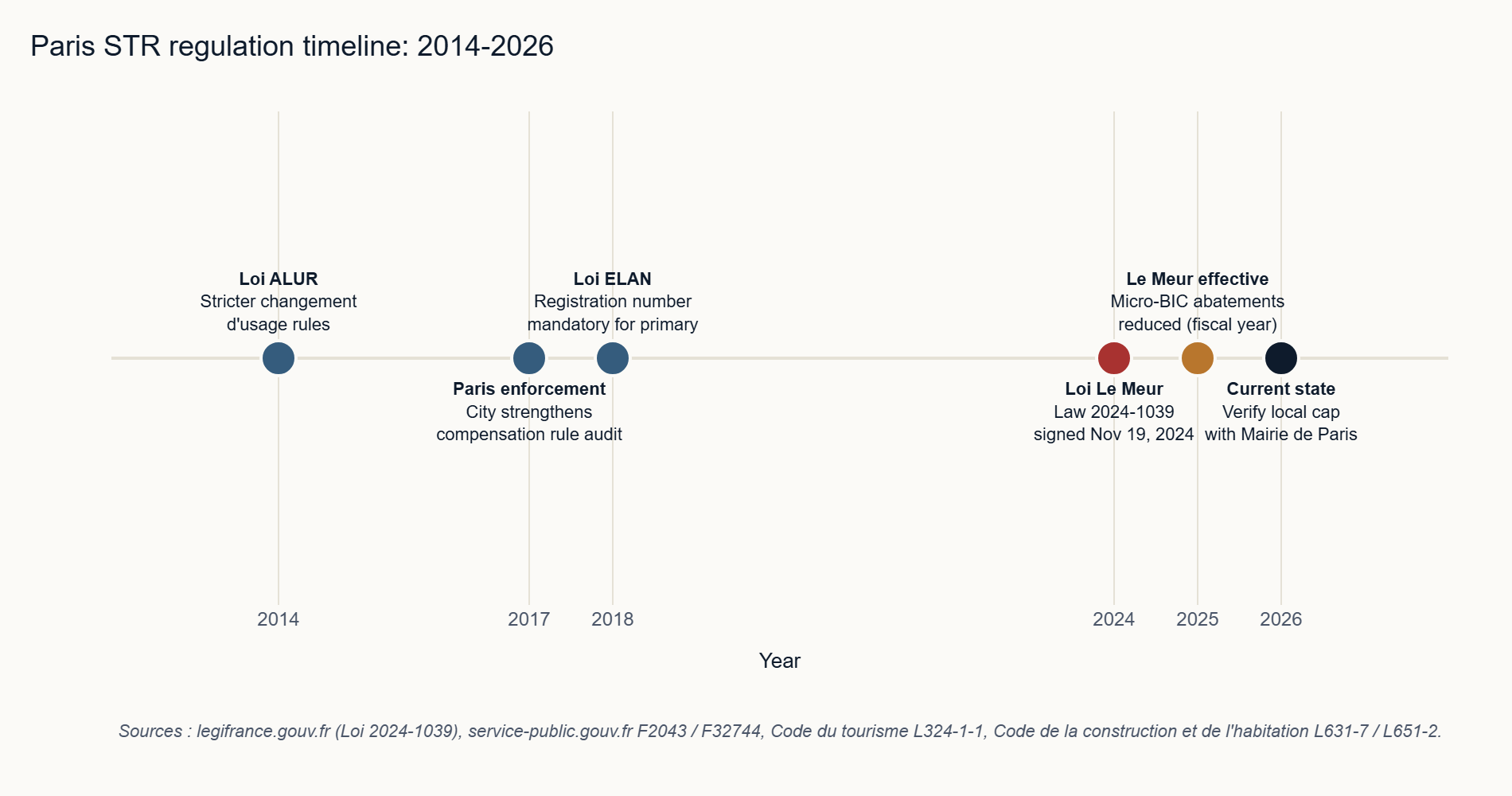
Four provisions from Law 2024-1039 affect Paris operators regardless of whether they are on the primary or secondary path.
Municipalities can lower the annual cap. Covered above - Paris has set a local cap of 90 days for primary residences (down from the national default of 120). This applies only to primary residences (secondary residences require authorization, not a night cap).
Stricter platform data reporting. Platforms must now report STR activity data to municipalities annually, including night counts per listing. This closes a tracking gap that previously let activity go undetected when operators distributed stays across multiple platforms. The practical effect: cross-platform totals are now visible to the Mairie, not just per-platform activity.
Tax abatement changes. Per Law 2024-1039 (loi Le Meur) and confirmed by service-public.gouv.fr - Revenus d’une location meublée, the micro-BIC flat-rate deduction for meublé de tourisme income has been reduced, effective for fiscal year 2025 income:
- Classified meublés de tourisme (certified by an approved body): abatement reduced from 71% to 50%
- Non-classified meublés de tourisme: abatement reduced from 50% to 30%
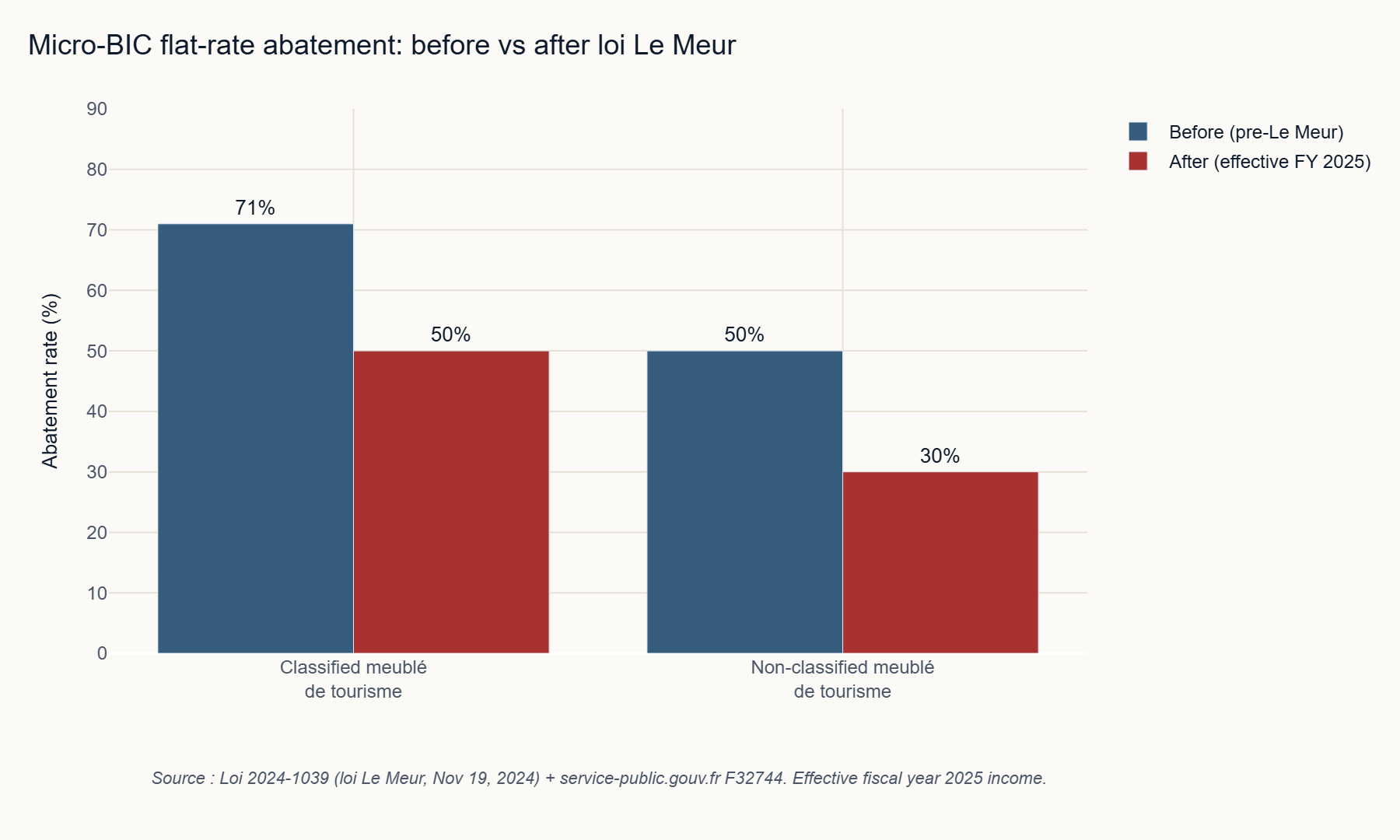
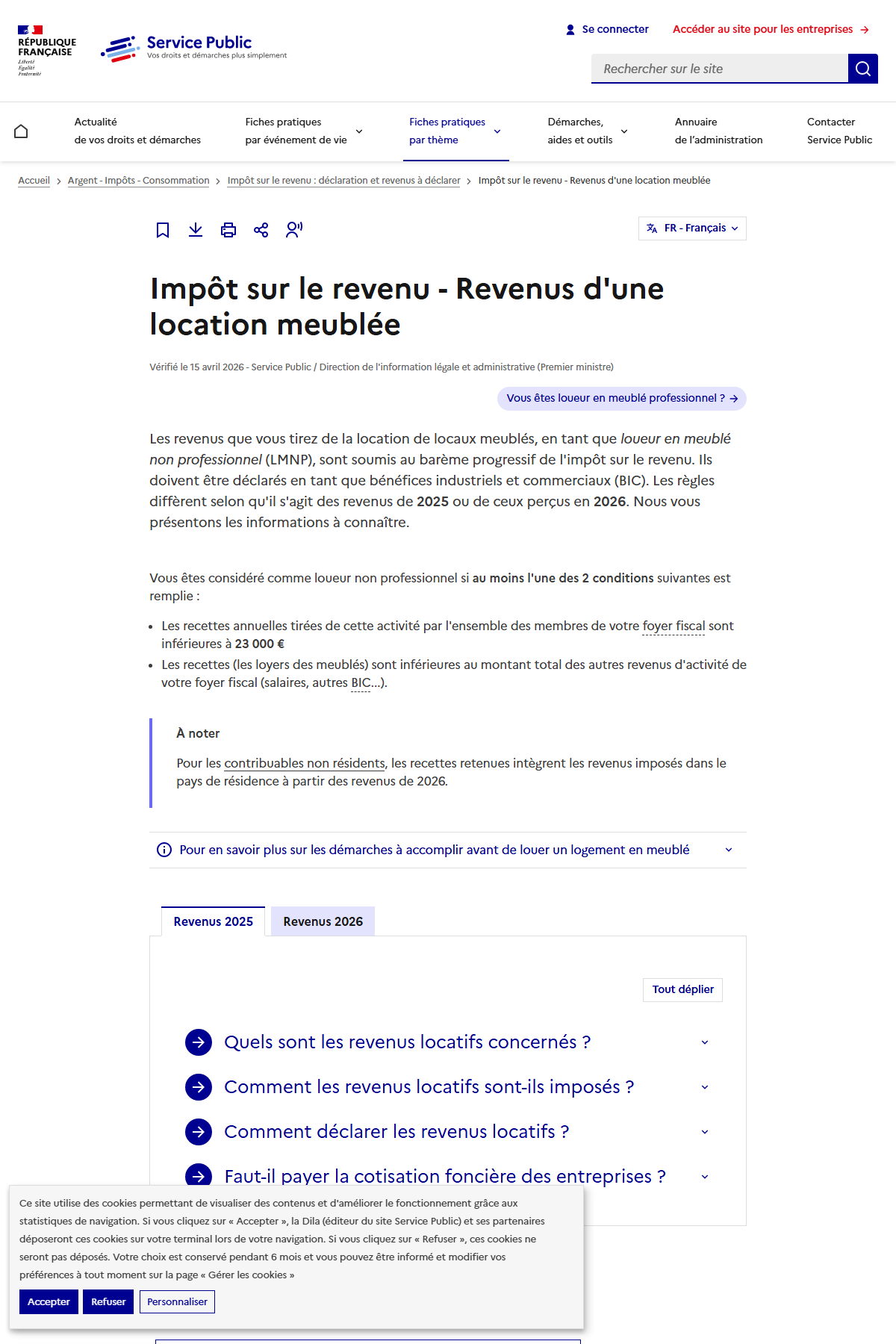
If you have been using the micro-BIC regime to simplify STR income declaration, recalculate your net tax exposure for 2025 onwards. The regime remains available but is less favorable. Confirm current applicable rates at service-public.gouv.fr or with an expert-comptable.
Quota powers for secondary STR. Municipalities can now cap the total number of secondary STR authorizations per neighborhood, not just the activity level of individual operators. Paris can use this to set a hard ceiling on total secondary STR stock per arrondissement - a tool the city has wanted for years.
Four pitfalls that catch Paris operators
Counting reservations instead of nights. The 90-night cap counts check-in nights, not bookings. A single reservation covering 7 nights counts as 7. Operators who track by reservation count consistently misestimate their exposure.
Trusting Airbnb to cover multi-OTA compliance. Airbnb’s 90-night block applies to Airbnb activity on listings configured as primary residences. It does not know about your Vrbo or Booking.com nights. The legal cap is aggregate across all channels.
Missing the registration number before listing, not after. The registration number must be in place before the first listing goes live. Retroactive compliance after a booking is complete does not eliminate the fine exposure for the unlisted period. The clock starts from when the listing was published without the number.
Assuming the secondary residence path is just more paperwork. Operators who discover the compensation requirement mid-process often lose months to a dead-end application. If your Paris property is a secondary residence and you do not have a pre-2015 changement d’usage authorization or the capital to acquire compensation commercial space, the STR path is effectively closed. The changement d’usage requirement applies from the first night of commercial STR use; verify all applicable requirements with a licensed French property lawyer before signing any purchase or lease agreement.
Sources cited
Primary Paris cap re-verified via Ville de Paris July 2026; underlying Code du tourisme framework last reviewed May 2026.
- Code du tourisme, Article L324-1-1 - legifrance.gouv.fr
- Code de la construction et de l’habitation, Article L651-2 - legifrance.gouv.fr (navigate to Article L651-2)
- Loi Le Meur, Law 2024-1039, November 19, 2024 - legifrance.gouv.fr
- Service-public.gouv.fr - Location en meublé de tourisme (résidence secondaire) - service-public.gouv.fr (last reviewed May 2026)
- Service-public.gouv.fr - Revenus d’une location meublée (micro-BIC) - service-public.gouv.fr (last reviewed May 2026)
- Official Paris teledeclaration portal for meublés de tourisme
- Ville de Paris, furnished vacation rental rules - paris.fr (verified live, July 2026)
Regulations cited reflect Article L324-1-1 of the Code du tourisme (as modified by loi ALUR 2014, loi ELAN 2018, and loi Le Meur November 2024) and Paris municipal rules on changement d’usage. Information current as of July 2026. Paris STR regulations change.
YMYL Disclaimer: This article is informational only and does not constitute legal or tax advice. Fine amounts, night caps, tax rates, and procedural details cited are based on publicly documented French law as of July 2026 and may have changed. Verify all regulatory requirements with a licensed French property lawyer (avocat spécialisé en droit immobilier) or directly with the Mairie de Paris before listing any short-term rental property in Paris. The Mairie de Paris Direction du Logement et de l’Habitat can be reached through the official paris.fr portal.
Frequently asked questions
- Does the 90-night annual cap apply to all Paris STR operators?
- Only to primary residences. If the property is your principal place of residence (where you live at least 8 months per year, per [Article L324-1-1 of the Code du tourisme](https://www.legifrance.gouv.fr/codes/article_lc/LEGIARTI000037671356/)), the cap is 90 nights per calendar year in Paris (Paris lowered it from the national 120-night default under loi Le Meur, per [Ville de Paris](https://www.paris.fr/en/pages/furnished-vacation-rentals-rules-to-follow-34993)). Secondary residences are not subject to the cap but require a changement d'usage authorization instead, which Paris grants rarely. Verify current rules at [service-public.gouv.fr](https://www.service-public.gouv.fr/particuliers/vosdroits/F2043).
- What is a registration number (numero de declaration) and do I need one?
- Yes, for any STR in Paris. The registration number is obtained by filing a teledeclaration with the Mairie de Paris before your first rental night. It must appear on all listing platforms (Airbnb, Vrbo, Booking.com). Operating without one is a violation of [Article L324-1-1 of the Code du tourisme](https://www.legifrance.gouv.fr/codes/article_lc/LEGIARTI000037671356/) and triggers fines. The declaration is submitted through the [official Paris teledeclaration portal](https://teleservices.paris.fr/meubles-tourisme/) and the [service-public.gouv.fr guide on furnished tourist rentals](https://www.service-public.gouv.fr/particuliers/vosdroits/F2043).
- What did loi Le Meur (November 2024) change for Paris STR operators?
- [Law 2024-1039 (loi Le Meur, November 19, 2024)](https://www.legifrance.gouv.fr/jorf/id/JORFTEXT000050624473) gave municipalities the power to lower the annual STR cap below 120 days, to a minimum of 90 days. It also introduced stricter platform reporting obligations and reduced tax abatements for meuble de tourisme income, per [service-public.gouv.fr](https://www.service-public.gouv.fr/particuliers/vosdroits/F2043). As of July 2026, Paris has implemented the 90-day cap for primary residences (source: [Ville de Paris](https://www.paris.fr/en/pages/furnished-vacation-rentals-rules-to-follow-34993)). The national default remains 120 days for municipalities that have not lowered it.
- Can I legally rent my secondary Paris property on Airbnb?
- Only with a changement d'usage authorization from the Mairie de Paris, which also requires converting an equivalent surface of commercial space to residential use in the same arrondissement. In practice, Paris grants very few new authorizations. Operating without one exposes you to civil penalties per [Article L651-2 of the Code de la construction et de l'habitation](https://www.legifrance.gouv.fr/codes/article_lc/LEGIARTI000038814878/). Consult a French property lawyer before listing any secondary Paris property.
- What fines apply for STR violations in Paris?
- Operating without a registration number: up to 5,000 EUR per listing per [Article L324-1-1 of the Code du tourisme](https://www.legifrance.gouv.fr/codes/article_lc/LEGIARTI000037671356/), as documented on [service-public.gouv.fr](https://www.service-public.gouv.fr/particuliers/vosdroits/F2043). Platforms hosting non-registered listings face separate civil penalties under the Code du tourisme platform accountability provisions; consult the [current consolidated text at legifrance.gouv.fr](https://www.legifrance.gouv.fr/codes/section_lc/LEGITEXT000006074073/LEGISCTA000037671352/) for applicable amounts. For secondary residences rented without changement d'usage authorization, civil penalties under [Article L651-2 of the Code de la construction et de l'habitation](https://www.legifrance.gouv.fr/codes/article_lc/LEGIARTI000038814878/) can reach 100,000 EUR, plus forced return to residential use, per [service-public.gouv.fr](https://www.service-public.gouv.fr/particuliers/vosdroits/F32744).
- Does Airbnb automatically block Paris listings after 90 nights?
- Airbnb blocks additional bookings once a primary-residence Paris listing reaches the applicable annual cap (90 nights in Paris as of July 2026), but only if you have configured the listing as a primary residence on Airbnb. Vrbo and Booking.com do not enforce this limit automatically. Operators managing multiple OTAs must track night counts manually across all channels, since cross-platform enforcement is not built in.